


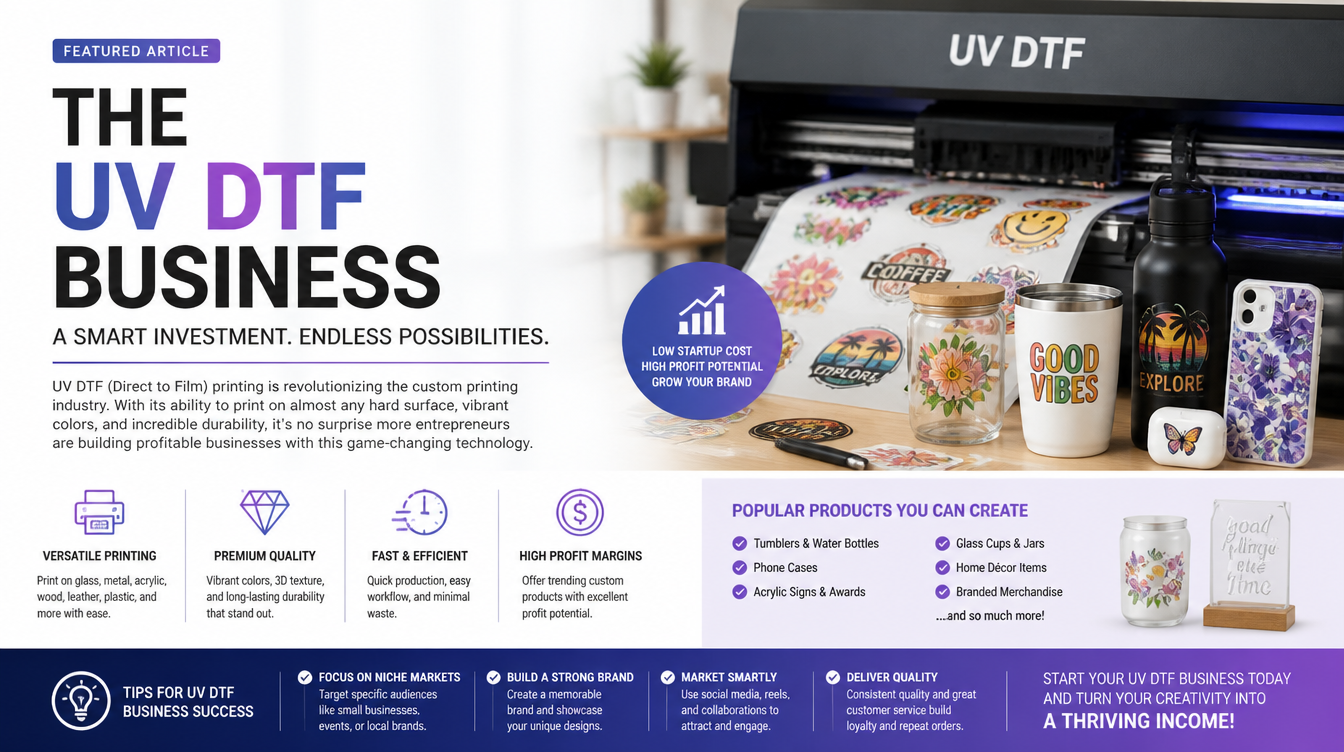
The Ultimate Guide to Starting a UV DTF Business in 2026
If you have been watching the custom printing space over the last two years, you already know that the apparel printing market is heavily saturated. Everyone and their neighbor has a basic t-shirt press. But right now, there is a massive gold rush happening in a completely different, highly profitable sector: decorating rigid, hard surfaces. The secret weapon driving this trend? UV Direct-to-Film (UV DTF) printing.
Figuring out exactly how to start a uv dtf business in 2026 is one of the most lucrative, high-margin moves a print shop owner or hobbyist crafter can make today. Why? Because unlike traditional methods, UV DTF allows you to apply high-gloss, 3D, waterproof decals to almost any hard surface in seconds—without needing a heat press, a convection oven, or expensive sublimation blanks.
In this comprehensive guide, we are going to walk you through exactly what UV DTF is, the commercial equipment you need to launch, a breakdown of your startup costs and profit margins, and how to position your new brand in the 2026 print-on-demand landscape.
The Core Advantage: UV DTF allows you to bypass the massive limitations of sublimation (which requires polyester coatings and high heat) and standard DTF (which requires fabric). UV DTF sticks permanently to glass, wood, metal, ceramics, and plastic with a simple peel-and-stick application.
What is UV DTF Printing? (The Science Behind the Magic)
Before you invest capital into a new business, you need to understand the technology. UV DTF stands for Ultraviolet Direct-to-Film. It is a process that marries the durability of industrial UV flatbed printing with the flexibility of a sticker.
Here is how it works: Instead of printing directly onto an object (like a traditional UV flatbed printer does), the machine prints the ink onto a special transfer film (known as the A Film). Immediately as the ink is laid down, powerful UV LED lights cure (dry and harden) the ink instantly. Finally, a clear layer of UV varnish is printed over the top to give it a 3D, embossed texture. After printing, a laminator applies a sticky carrier sheet (the B Film) over the design.
The result? You have a permanent, waterproof, scratch-resistant decal that you can peel and stick onto virtually anything. No heat tape, no ovens, and no cooling racks required.
What Equipment Do You Need to Get Started?
Unlike basic crafting setups (like a Cricut or a cheap sublimation printer), UV DTF requires a commercial-grade machine. However, the barrier to entry has plummeted in 2026, making it highly accessible for small businesses.

1. A Commercial UV DTF Printer
This is the heart of your business. These machines use specialized printheads (often Epson i3200 or XP600 heads) and UV LED lights. You will want a “roll-to-roll” machine rather than a flatbed. An integrated roll-to-roll machine prints on a continuous roll of A Film and automatically laminates it with the B Film in one fluid motion. Check out reputable commercial manufacturers like Roland DGA or ColDesi for top-tier equipment that offers robust warranty support.
2. UV Inks, White Ink, and Varnish
Your printer will use CMYK inks, plus two crucial additions: White Ink and Varnish. The white ink allows you to print on dark surfaces (like black tumblers or tinted glass) without the design looking washed out. The varnish is the secret ingredient that gives the decal its raised, ultra-glossy finish that feels incredibly premium to the touch.
3. Consumables: A Film and B Film
You will need a continuous supply of A Film (the base film you print on) and B Film (the transfer tape that goes on top). Buying these in bulk rolls is the key to keeping your cost-per-print incredibly low.
Cost Analysis and Profit Margins (The Business Plan)
Why are so many entrepreneurs jumping into UV DTF in 2026? It all comes down to the math. Let’s look at the profit margins.
While the initial printer investment might range from $4,000 to $10,000 depending on the size and brand, your consumable cost is shockingly low. Printing a standard 16oz tumbler wrap using UV DTF costs roughly $0.50 to $0.80 in ink and film. A blank glass cup might cost you $2.00.
However, customers are willing to pay a premium for products that look professionally manufactured. A handmade tumbler with a cheap, flat vinyl sticker looks amateurish and might sell for $12. That same tumbler with a permanent, raised, glossy UV DTF decal looks like it was bought in a high-end boutique and easily retails for $25 to $35.
Your profit margin on a single custom cup can exceed 80%. When you scale this up to bulk B2B orders (e.g., printing 500 branded mugs for a local corporate event), the ROI on the printer is realized in a matter of months.
Replacing Sublimation: Why Businesses are Making the Switch
For years, sublimation was the king of the hard-surface custom printing world. But UV DTF is rapidly replacing it. With sublimation, you are strictly limited to polyester-coated blanks. You cannot sublimate on dark colors, and you have to deal with the headache of heat presses, convection ovens, shrink wrap, and “ghosting” errors.
UV DTF eliminates all of that overhead. If you’re still on the fence about leaving your sublimation setup behind, check out our deep dive comparison: UV DTF vs Sublimation: Which is Best for Tumblers and Mugs? to see exactly why six-figure businesses are making the switch.
Scaling Your Production and Finding Niches
Because you do not need heat to apply UV DTF, your production bottleneck vanishes. You simply peel, stick, rub, and peel away the carrier sheet. This allows you to decorate a massive variety of blank products that would melt in a heat press.
To succeed in 2026, you shouldn’t just sell “custom cups.” You need to find a niche. You could focus exclusively on wedding decor (custom wine bottles and acrylic seating charts), or you could target the corporate gifting sector. Curious about exactly what substrates you can offer? Read our extensive guide on the Top 5 Hard Surfaces You Can Print on With UV DTF Transfers.
Frequently Asked Questions (FAQ)
Is UV DTF dishwasher safe?
While UV DTF is highly water-resistant and durable, most professionals recommend hand-washing decorated drinkware. The extreme heat and harsh chemicals of commercial dishwashers can degrade the glossy varnish layer over time.
Do I need a special room for a UV DTF printer?
Yes. UV inks have a strong odor and can emit VOCs (Volatile Organic Compounds) during the curing process. You must operate the printer in a well-ventilated room or invest in a proper fume extraction system to ensure a safe working environment.
Can I use standard DTF ink in a UV printer?
Absolutely not. Standard DTF ink is water-based and designed to bond with adhesive powder and melt into fabric via a heat press. UV ink is a completely different chemical composition designed to instantly cure under ultraviolet light. Mixing them will permanently destroy your expensive printheads.
