


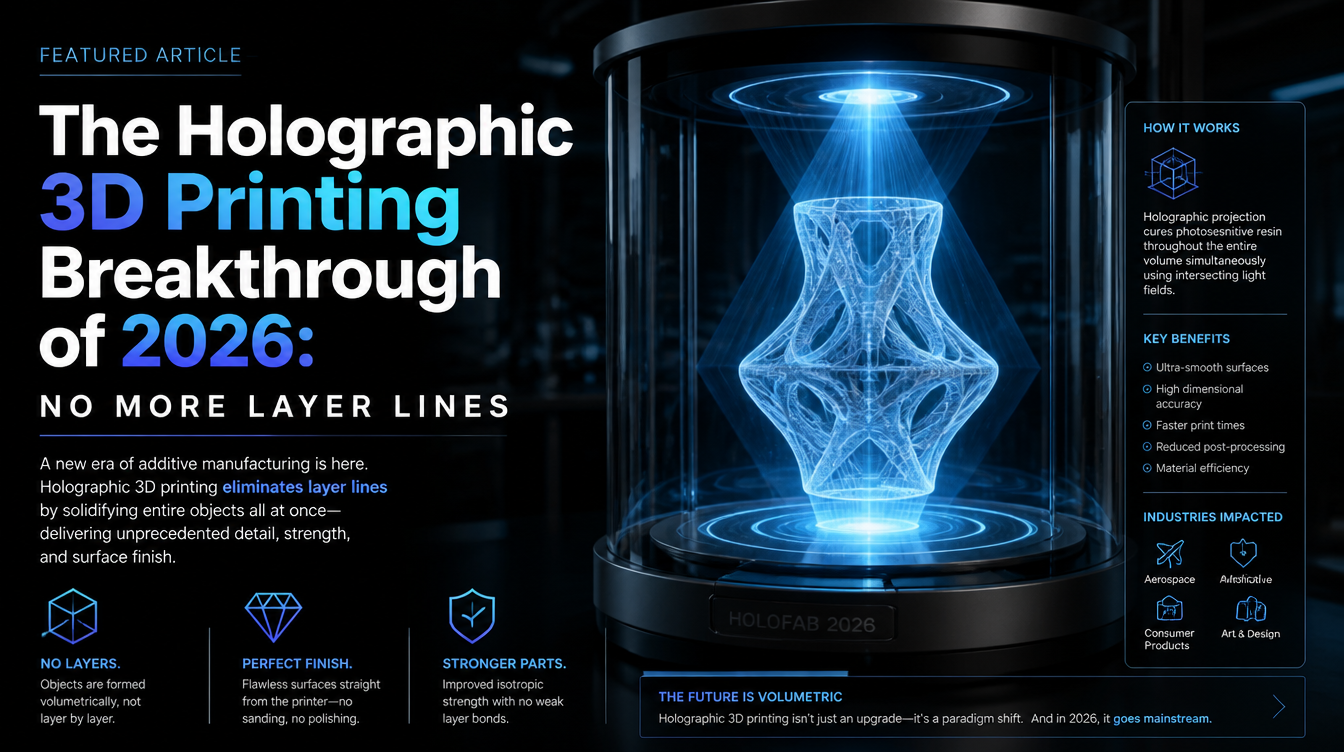
The Holographic 3D Printing Breakthrough of 2026: No More Layer Lines

For decades, the biggest limitation of 3D printing has been the layers. Whether you use a budget FDM machine or a high-end commercial resin printer, the object is built slice by slice. This layer-by-layer approach leaves visible seams, creating weak points that are prone to leaking or snapping under pressure.
This week, that limitation was completely shattered. Researchers at the University of Utah have announced a massive holographic 3D printing breakthrough in 2026, demonstrating a method that prints complex, seamless microstructures in just 20 seconds.
The Core Innovation: Instead of building an object layer-by-layer, this new method uses a single flash of shaped laser light to instantly solidify the entire 3D shape all at once.
How “Holographic” Printing Works
Led by Professor Rajesh Menon, the research team in the Department of Electrical & Computer Engineering moved away from traditional stereolithography. Instead of a laser tracing a path, they designed highly specialized nanoscale masks.
These masks act like highly advanced light filters. When a standard laser beam is passed through the mask, the light diffracts into a precise, complex 3D holographic shape. This “sculpted” light is then projected directly into a vat of photopolymer resin.
- The Material: The process relies on SU-8, a common polymer resin that cross-links and hardens instantly when exposed to the specific wavelength of the laser light.
- The Speed: Because the entire volume of the object is exposed to the laser simultaneously, a complex geometric structure can be cured in approximately 20 seconds.
- The Result: Once the unexposed liquid is washed away, you are left with a perfectly seamless object. There are no layer lines, meaning there are no weak structural joints.

What This Means for the Industry
This breakthrough, recently published in the prestigious journal Nature Communications, has massive implications for fields that require perfectly sealed microstructures, such as medical implants, micro-fluidics, and advanced optics.
“By eliminating the layer lines entirely, we are no longer just printing objects; we are instantly synthesizing solid structural geometries.”
Will this replace your home 3D printer?
Not yet. The researchers note that this technology is currently classified as “extended 2D.” Because the laser light must pass completely through the vat of liquid, it is currently best suited for printing intricate, lattice-like structures (like synthetic blood vessels or mesh) rather than solid, bulky objects like toys or cosplay helmets.
For now, if you are looking to print household items or solid prototypes, you will still want to rely on the traditional machines listed in our Best 3D Printers for Your Home guide, and stock up on standard 3D printing materials.
However, as the optical algorithms improve, this 20-second holographic flash could very well become the standard for commercial manufacturing by the end of the decade.
