


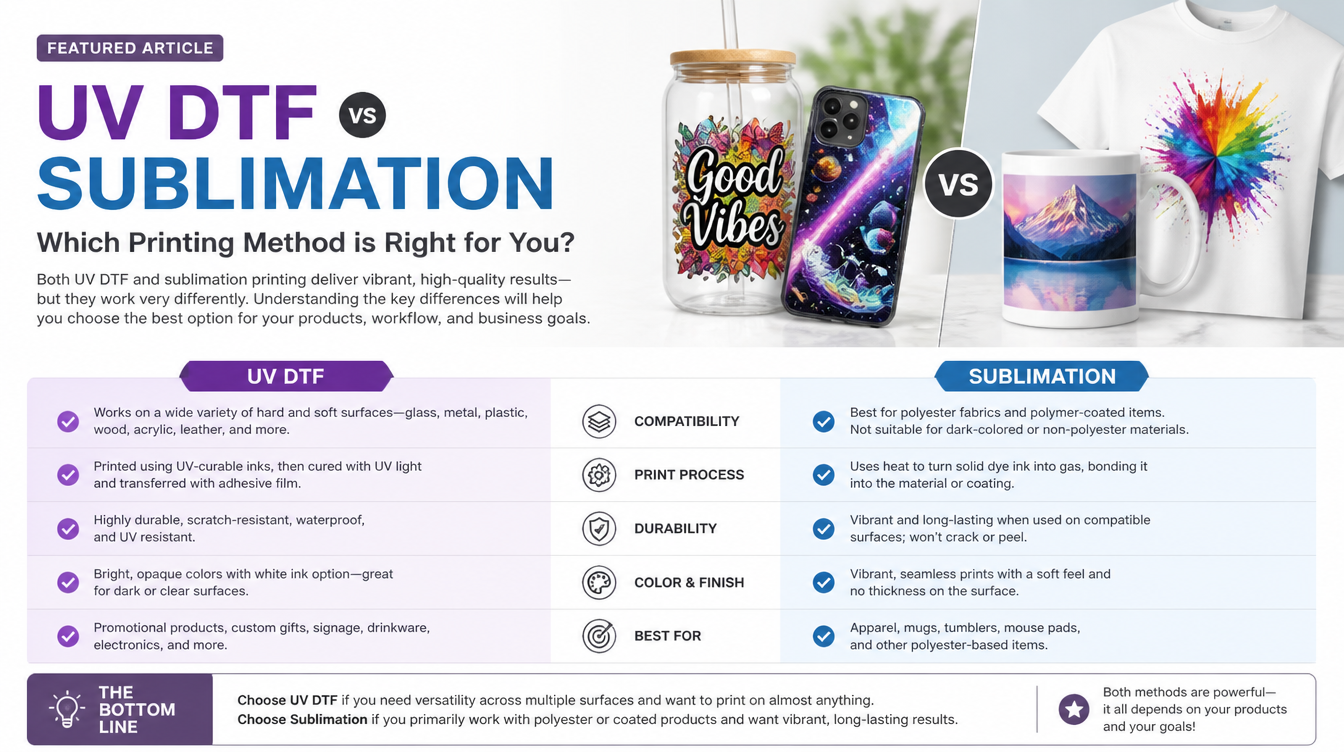
UV DTF vs Sublimation: Which is Best for Tumblers and Mugs?
If you are in the drinkware customization business, you have likely relied on sublimation for years. Sublimation has been the undisputed gold standard for producing full-color, permanent, photographic designs on mugs, water bottles, and tumblers. But the landscape of custom printing is evolving rapidly, and in 2026, a massive shift is occurring.
When comparing uv dtf vs sublimation for tumblers, crafters and small commercial business owners are rapidly abandoning their convection ovens and tumbler heat presses in favor of peel-and-stick UV technology. But why fix what isn’t broken? Is UV DTF actually better, or is it just the latest fad?
In this deep dive comparison, we will break down the fundamental differences between these two technologies, examine their limitations, and explain exactly why UV DTF is dominating the high-end drinkware market this year.
The Limits of Sublimation (Why People are Frustrated)
Sublimation is a fascinating chemical process. Using special sublimation ink, you print your design onto a transfer paper. When that paper is taped tightly to a blank and heated to around 400°F (204°C), the solid ink turns directly into a gas and permanently bonds with the polymer coating on the cup. While the results are beautifully flat and seamless, there are three massive, inherent drawbacks that limit your business scalability:
- The Polymer Coating Requirement: You cannot sublimate on just any cup from the dollar store or a standard Yeti cooler. You must buy specialized, polymer-coated blanks from suppliers like Conde Systems. This significantly reduces your blank sourcing options and increases your base cost.
- Severe Color Restrictions: Sublimation printers do not print white ink. The “white” in your design is simply the absence of ink, meaning the color of the cup shows through. Therefore, you can only sublimate onto white or very light-colored tumblers. If you try to sublimate on a black cup, the design will be invisible.
- Expensive Heat Equipment and Ghosting: You need expensive tumbler heat presses or specialized convection ovens. Furthermore, the process is notoriously prone to “ghosting”—if your heat tape isn’t perfectly tight or the paper shifts by a millimeter during cooling, your design comes out blurry, and the expensive blank is ruined.
The UV DTF Difference: UV DTF transfers completely bypass these headaches. They do not require heat, they do not require special polymer coatings, and because they utilize a white ink base layer, they show up vibrantly on dark, black, and completely transparent glass tumblers!

Application Speed, Texture, and The Premium Feel
Beyond the technical limitations, the aesthetic difference between the two methods is massive. Sublimation leaves a completely flat finish that feels exactly like the original cup. While this is great for some applications, it can sometimes feel a bit generic.
UV DTF, however, prints a thick layer of UV-cured varnish over the top of the CMYK design. This results in an embossed, 3D texture that catches the light and feels incredibly high-end in the hand. When a customer picks up a UV DTF tumbler, they can feel the ridges of the design. It feels like an expensive, commercially manufactured product rather than a DIY craft.
Furthermore, applying a UV DTF wrap takes a fraction of the time. You simply align the decal, squeegee it on to remove air bubbles, and peel off the carrier sheet. There is no heat tape, no waiting for ovens to preheat, and no waiting for scalding hot cups to cool down on a rack.
| Feature | Sublimation | UV DTF |
|---|---|---|
| Can Print White Ink? | No (Light blanks only) | Yes (Vibrant on dark/black cups) |
| Requires Special Blanks? | Yes (Polymer-coated only) | No (Works on almost any hard surface) |
| Application Method | 400°F Heat Press / Oven | Cold Peel and Stick |
| Texture | Completely Flat / Flush | Raised, 3D, High-Gloss Varnish |
Are There Downsides to UV DTF?
To be fair in our comparison, UV DTF is not perfect. The primary downside is dishwasher safety. Sublimation actually dyes the coating of the cup, meaning it is largely dishwasher and microwave safe. UV DTF is fundamentally a high-tech sticker. While the industrial adhesive is incredibly strong and waterproof, the extreme heat and harsh chemicals of commercial dishwashers can eventually cause the edges of the varnish to chip. Hand-washing is heavily recommended for UV DTF products.
Additionally, the startup cost for the equipment is vastly different. You can start sublimating for under $500. A commercial UV DTF machine is a multi-thousand-dollar investment.
The Verdict
If you are a hobbyist just making a few cups a month for family, sublimation is still the cheapest entry point. However, if you run a business and want to scale your production, eliminate heat-ruined inventory, and charge a premium price for 3D textured drinkware, UV DTF is the undisputed winner in 2026.
If this sounds like the upgrade your shop needs, make sure you read our comprehensive guide on How to Start a UV DTF Business in 2026 to learn exactly what machinery you need to get started. And remember, tumblers are just the beginning; you can also apply this technology to dozens of other hard surfaces across multiple industries.

1 Comment
Pingback: The Ultimate Guide To Starting A UV DTF Business In 2026 - Print Minute