


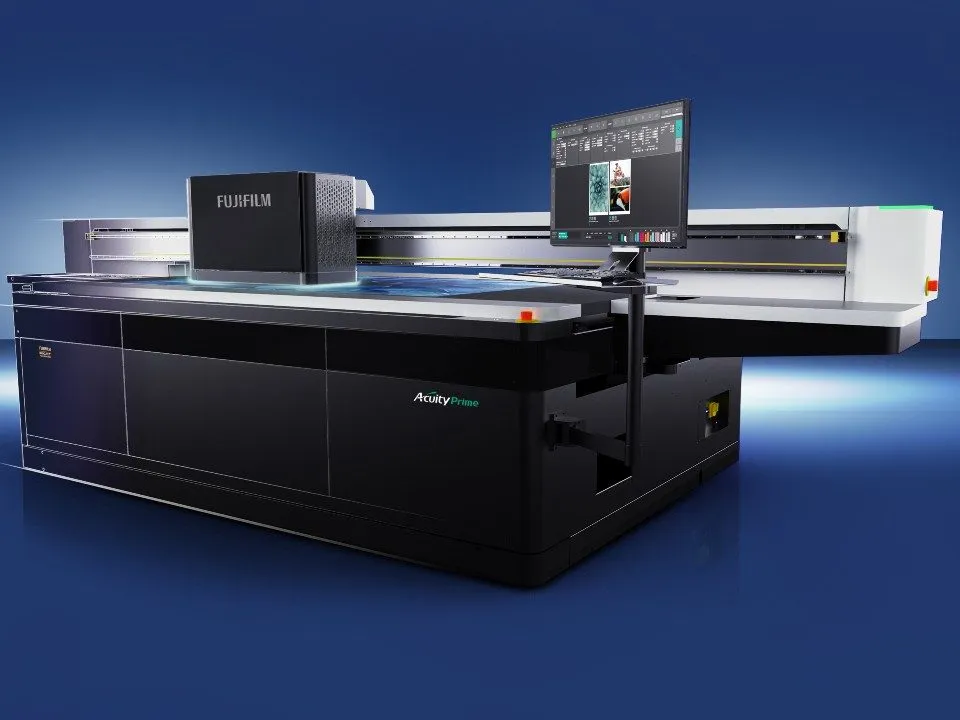
If you are a print shop owner who relies on high-end commercial print hardware, the recent headlines might have caused some anxiety. With the Spring 2026 announcement that the Fujifilm Acuity Prime is discontinued and Fujifilm Acuity Ultra sales ended, many business owners are left wondering about the future of their production floors.
Are your expensive machines suddenly obsolete? Will you still be able to source ink and replacement parts?
In short: Don’t panic. While the Fujifilm wide-format inkjet lineup is undergoing significant changes, your existing equipment is not going dark overnight. Here is a complete breakdown of the recent announcements, the hard market data driving these changes, and what it means for your print shop equipment investment.
The Announcement: Acuity Prime and Acuity Ultra Phase-Out
In April 2026, Fujifilm confirmed to industry outlets and staff that it is ceasing the sale of new devices in the Acuity Prime and Acuity Ultra product lines. The company stated that existing inventory of these models will be steadily reduced by the Summer of 2026. This withdrawal primarily targets the North American and European markets.
This move follows earlier decisions in 2026 to withdraw European sales of certain commercial models like the Jet Press 750S and 1160 web press. This signals broader print industry structural reforms within the company. However, this strategic shift does not mean Fujifilm is abandoning the inkjet market a segment that still accounts for roughly 29% of its massive ¥850 Billion Business Innovation division. Instead, it marks a pivot toward more profitable, high-growth segments of the industry.
The Big Question: Will I Still Get Printer Service and Support?
For print service providers (PSPs) currently running an Acuity Prime flatbed or Acuity Ultra roll-to-roll printer, your immediate concern is naturally about operational continuity.
The good news is that Fujifilm has made a firm, public commitment to its existing customer base. The company officially stated that:
- Consumables remain available: The supply of specialized UV Jet inks and necessary consumables for existing machines will continue seamlessly.
- Maintenance continues: Robust printer service and support will still be offered to fulfill all contractual obligations, warranties, and service agreements.
- No immediate obsolescence: Your machines will be fully supported for their reasonable operational lifespan.
You do not need to abruptly halt production or scramble for aftermarket parts. Your current workflow and revenue streams remain secure.
The Business Data: Why is Fujifilm Scaling Back?
The decision by FUJIFILM Business Innovation and the Graphic Communications division to scale back these specific wide-format lines comes down to rapidly shifting market dynamics and corporate profitability targets.
While the global wide-format printing market is vast projected to reach a market size of $20.7 billion in 2026 with a 6.7% CAGR through 2035 the hardware segment has matured. Fujifilm attributes its structural reforms to several data-backed industry pressures:
- Downward ASP & Competitive Pressures: A surge in highly competitive, lower-cost alternatives particularly from Chinese manufacturers has commoditized the mid-tier flatbed and roll-to-roll hardware space. This has led to a noticeable decline in Average Selling Prices (ASPs), squeezing profit margins for premium legacy brands.
- Economic Headwinds in Print: Commercial printing is facing a tight economic landscape. Recent industry data shows that operating cost inflation (roughly 3.9%) has outpaced print price increases (2.1%), leading to over 72% of commercial printers reporting flat or declining pre-tax profitability.
- Changing Customer Needs: As standard commercial print volumes decline due to digital communication shifts, PSPs are demanding more automated, specialized solutions rather than simply adding more raw printing capacity.
To adapt, Fujifilm is implementing a “Horizon” strategy: optimizing mature, low-margin segments (like standard UV flatbeds) to free up capital for high-margin, transformative technologies.
What is the Future of Fujifilm Commercial Print Hardware?
While the Acuity Prime and Ultra are stepping out of the spotlight, Fujifilm is doubling down on other areas of commercial print hardware where they see sustainable growth and stronger barriers to entry.
Moving forward, expect to see FUJIFILM Business Innovation place a heavier emphasis on:
- The Fujifilm Revoria Press: The company’s highly successful line of toner-based digital presses remains a massive priority for the commercial print sector, offering incredible specialty color capabilities and media versatility.
- Packaging and Specialty Inkjet: Focus is shifting toward high-growth, lucrative areas like flexible packaging. The rollout of the Jet Press FP790 for packaging and the Acuity Triton which utilizes Fujifilm’s proprietary Aquafuze water-based UV ink technology will be primary focal points for 2026 and beyond.
- Digital Transformation (DX) & AI: Integrating print hardware with advanced, AI-driven workflow software to help print shops reduce labor costs and increase world-class efficiency.
How This Impacts Your Print Shop Equipment Investment
If you currently own an Acuity Prime or Ultra, your smartest print shop equipment investment strategy right now is to stay the course. Because printer service and support are guaranteed, you can continue to monetize your existing hardware without interruption. Focus on maximizing the ROI of your current machine through workflow automation and routine maintenance.
If you were previously shopping for a new Acuity Prime or Ultra, you will need to pivot. Your options include:
- Securing one of the final remaining inventory units before Summer 2026 (potentially leveraging this phase-out to negotiate a highly favorable capital expenditure deal).
- Evaluating alternative wide-format solutions that align with the new realities of the market, placing a premium on workflow automation, ink efficiency, and long-term vendor stability.
Final Thoughts
The news that the Fujifilm Acuity Prime discontinued its run and Fujifilm Acuity Ultra sales ended is undoubtedly a major shift in the wide-format landscape. However, it is a reflection of a maturing market and macroeconomic shifts, not an abandonment of the print industry. By ensuring continued ink and service support, Fujifilm has safeguarded its users’ investments, allowing print shops to keep their presses running profitably while the industry continues its digital evolution.
