


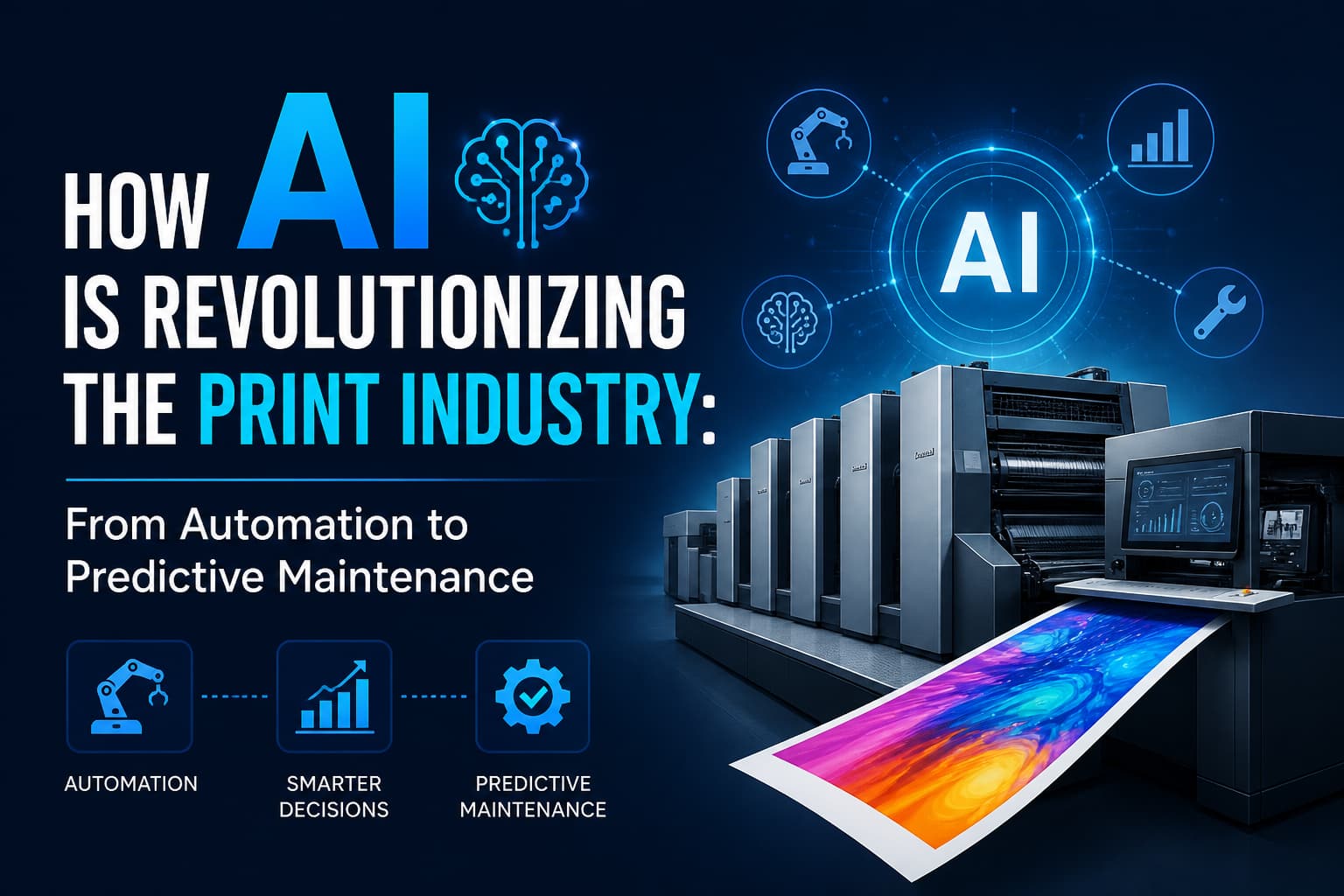
Think the print industry is just dusty presses and old-school ink? Think again. The printing press just got a massive brain upgrade. Behind the scenes, artificial intelligence is turning traditional print shops into high-speed, data-driven powerhouses. From practically reading customers’ minds to fixing machines before they even break, AI is injecting serious adrenaline into every aspect of commercial printing.
The Rise of Artificial Intelligence in the Printing Industry
Let’s get one thing straight: AI is no longer just a shiny buzzword for Silicon Valley. It’s the ultimate survival tool for commercial printers who want to crush the competition and speed up their workflows.
What is AI Print Automation?
AI print automation is the use of artificial intelligence algorithms and machine learning to instantly optimize and execute printing tasks with virtually zero human intervention, from prepping files to running the press. Think of it as a hyper-intelligent assistant that never sleeps. Instead of a human operator spending hours manually checking client files for correct bleed or resolution, AI software snaps into action and handles those repetitive headaches in milliseconds.
The Shift from Traditional Workflows to Machine Learning
Back in the day, printing was all about human intuition. A veteran press operator would rely on their “gut feeling” and years of squinting at color swatches to adjust ink densities. Today? We’re trading gut feelings for cold, hard data.
Modern shops are running on advanced print MIS (Management Information Systems). These machine learning systems chew through mountains of past job data to perfectly optimize your current print runs, turning what used to be a messy trial-and-error guessing game into exact, repeatable science.
Core Applications of AI in Commercial Printing
So, where is this AI actually doing the heavy lifting? It’s sweeping across the entire production floor, targeting the exact spots where time and money usually go down the drain.
Predictive Maintenance on Printing Presses
Imagine if your car could text you saying, “Hey, my left brake pad is going to snap next Tuesday at 2 PM, you should probably fix it.” That’s predictive maintenance.
By slapping Internet of Things (IoT) sensors onto mechanical press parts, printers can track temperature, vibration, and performance in real-time. AI algorithms crunch this data to predict precisely when a roller or belt is about to give out. The result? Massive downtime reduction. Shops can swap parts during off-hours instead of suffering a catastrophic, chaotic breakdown in the middle of a massive client run.
Automated Color Correction and Image Enhancement
Trying to hit the absolute perfect color match used to be a nightmare. AI is finally making it effortless:
- Intelligent Preflighting: AI software acts like an eagle-eyed bouncer, instantly spotting pixelated, low-res images and using upscaling algorithms to magically sharpen them before they ever hit the press.
- Dynamic Gamut Mapping: AI automatically translates standard RGB web files to the exact CMYK color gamut of your specific press. Boom—vibrant, accurate colors with zero manual tweaking.
- Real-time Adjustment: Inline cameras watch the paper fly by and feed data back to the AI, which micro-adjusts the ink keys on the fly. No more fading colors midway through a run.
Smart Layout and Imposition Software for Waste Reduction
Before a job prints, you have to fit it onto a giant sheet of paper to save space. AI imposition software is basically the world’s greatest Tetris player. In seconds, it calculates millions of possible geometric combinations, tightly “nesting” different client jobs together on a single sheet. This slashes offcut waste and saves a fortune on expensive paper.
Using AI for Hyper-Targeted Print Marketing
AI isn’t just making the printers run faster; it’s actually making the print smarter.
Analyzing Customer Data for Better Campaign ROI
Nobody likes generic junk mail. Today, printers and marketers use machine learning to deep-dive into consumer behaviors, past purchases, and demographics. The AI predicts exactly who is most likely to buy from a physical catalog, ensuring your marketing dollars are spent targeting guaranteed hot leads rather than random mailboxes.
Personalization at Scale: AI and Variable Data Printing (VDP)
Variable Data Printing (VDP) lets you change the text and images on a printed piece from one sheet to the next without stopping the machine. Mix VDP with AI, and things get wild:
- Dynamic Imagery: The AI can instantly swap the background photo on a postcard based on what the recipient bought last week.
- Tailored Copy: AI generates custom, snappy headlines tailored to each individual reader’s psychological profile.
- Automated Variations: You can churn out 10,000 completely unique, hyper-personalized mailers with a single click.
Bridging Digital and Physical Touchpoints
Print isn’t disconnected from the internet anymore. By dropping dynamically generated QR codes or Augmented Reality (AR) markers into physical prints, companies track real-world engagement live. The AI watches someone scan a brochure, and boom—it automatically triggers a personalized follow-up email 24 hours later.
The Business Benefits of Adopting AI Print Technologies
Why should a print shop owner care? Because AI is a straight line to higher profit margins.
Drastically Reducing Material Waste and Costs
Paper and ink are horribly expensive. Between the AI playing Tetris with your layouts (smart imposition), fixing colors automatically, and stopping machines before they break and ruin a batch, the amount of wasted material plummets. Less paper in the dumpster means more money in the bank.
Improving Turnaround Times and Operational Efficiency
Clients want Amazon-level speed. AI makes that happen:
- Instant Quoting: AI looks at real-time paper costs and press availability to fire off accurate quotes in seconds.
- Touchless Prepress: Files fly from the customer’s upload portal straight to the press queue. No human hands needed.
- Optimized Scheduling: A rush job comes in? The AI automatically reshuffles the entire shop floor schedule to make it fit without causing a pileup.
Solving Labor Shortages in the Print Shop
It’s tough to find skilled press operators right now. AI acts as a safety net, capturing the “tribal knowledge” of retiring printing veterans and baking it right into the software. Because the AI handles the complex, tedious tech stuff, your shop can pump out massive volume even with a leaner crew.
Challenges and the Future of AI in Print
It’s not all sunshine and rainbows, though. The transition to a futuristic print shop has its speed bumps.
Overcoming Implementation Costs and Training Hurdles
Upgrading an old-school print shop costs money. Slapping IoT sensors on a 20-year-old press isn’t always cheap or easy. Plus, your staff needs to unlearn decades of manual habits and learn how to manage software, which can definitely ruffle some feathers.
Will AI Replace Human Print Operators?
No, AI will not completely replace human print operators; instead, it will level them up, shifting their daily grind from boring, repetitive tasks to actually managing the smart systems and handling creative problem-solving. The print operator of the future isn’t going to be an ink-stained mechanic—they’re going to be a high-level systems director.
Emerging Trends to Watch in the Next 5 Years
Get ready for “lights-out” manufacturing. In the next five years, we’ll see autonomous print floors where robotic arms load the paper, and self-healing machines don’t just alert you to a broken part, but automatically adjust their own speed and pressure to compensate until the mechanic arrives.
Frequently Asked Questions (FAQs) About AI in Printing
How does AI improve print quality?
AI improves print quality by using highly advanced algorithms to instantly correct colors, upscale blurry images, and maintain flawless alignment while the press is running at top speed. Because the software uses pure data instead of tired human eyes, it totally eliminates those annoying color shifts and misprints.
What is predictive maintenance in commercial printing?
Predictive maintenance uses IoT sensors and machine learning to analyze the press in real-time, predicting exact mechanical failures before they happen so you can avoid surprise shutdowns. It watches things like heat and vibration to tell you exactly when to swap a part, keeping your presses running and your clients happy.
Can small print shops afford AI automation?
Yes, small print shops can easily afford AI today thanks to affordable cloud-based SaaS (Software as a Service) platforms and scalable Print MIS software that don’t require you to buy massive servers. Plus, many modern digital presses have these AI brains already built-in, giving the little guys enterprise-level power on day one.
