


Sublimation Printing for Tumblers vs Shirts: Which is More Profitable?
You have bought your best sublimation printer. You have your ink and paper. Now you face the most important business decision in the crafting world: What are you actually going to sell?
When getting started with sublimation printing, the two biggest money-makers are apparel (shirts, hoodies) and hard goods (tumblers, mugs). But they require entirely different heating equipment, have vastly different learning curves, and offer different profit margins.
In this guide, we are comparing sublimation printing for tumblers vs shirts to help you decide which path is right for your business.

Path 1: Sublimation on Shirts (Apparel)
Sublimating apparel is the traditional route. Because the ink permanently dyes the fabric rather than sitting on top of it, the resulting shirt is incredibly soft (zero “hand feel”) and will never crack or peel.
The Equipment Required
To sublimate shirts, you need a Flat Clamshell Heat Press (usually 15×15 inches or 16×20 inches). You simply lay the shirt flat, tape the transfer paper face down, and pull the heavy heated plate down over it.
The Biggest Limitation: Polyester
As we covered in our core guide, sublimation only works on polymers. You cannot sublimate a 100% cotton shirt. You must use shirts that are at least 65% polyester. Furthermore, because sublimation ink is transparent, you can only sublimate on white or very light-colored fabrics.
The Pros of Shirts:
- The pressing process is very easy for beginners.
- Flat heat presses are cheap and versatile (can also press mousepads and metal signs).
- No wrapping or shrinking required.
The Cons of Shirts:
- Limited to light-colored polyester (you cannot make black shirts).
- You are competing with millions of other t-shirt sellers on Etsy.
- Sizing issues (customers returning shirts that don’t fit).
Path 2: Sublimation on Tumblers (Hard Goods)
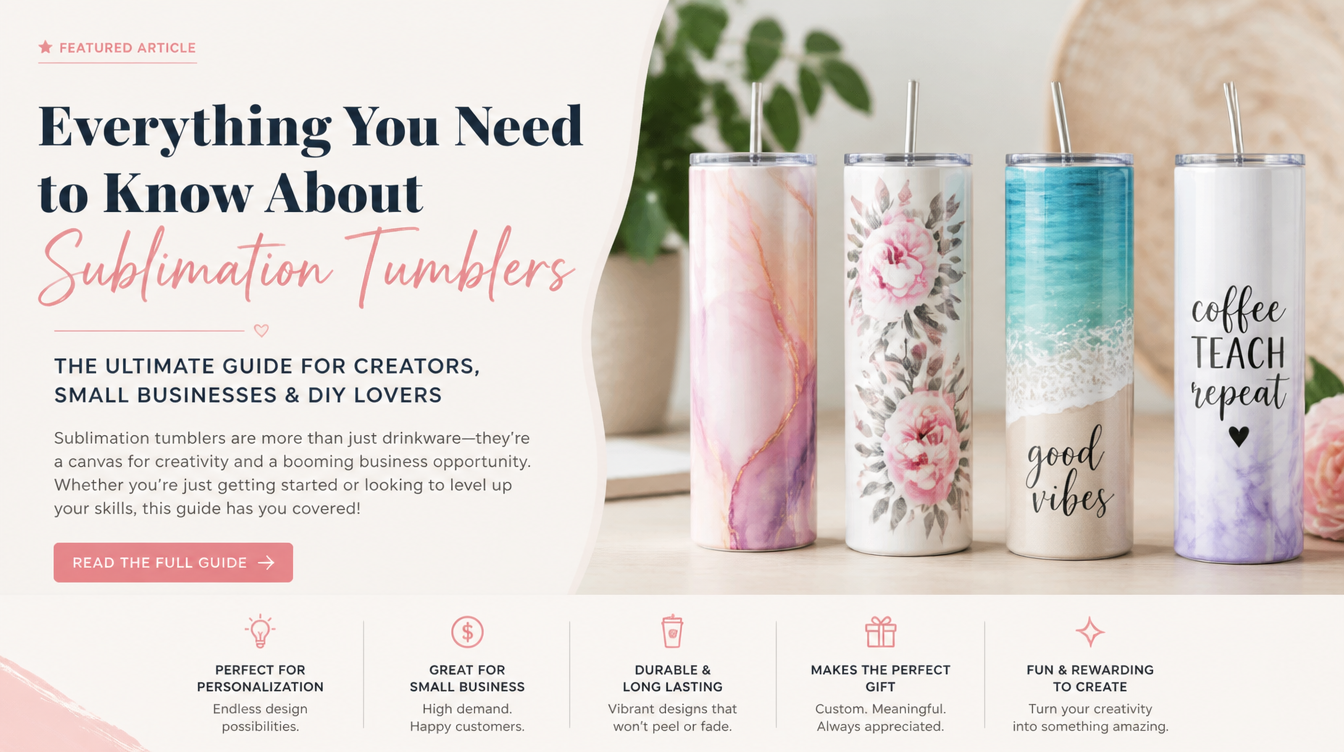
In recent years, the 20oz “Skinny Tumbler” has taken over the sublimation world. These stainless steel, double-walled cups hold ice for hours and can be completely wrapped in edge-to-edge, photo-realistic designs.
The Equipment Required
You cannot use a flat press on a cylinder. You have two options for tumblers:
- A Tumbler Press: A specialized machine with a curved heating element that wraps tightly around the cup.
- A Convection Oven: You wrap the tumbler in the paper, slide a plastic shrink-wrap sleeve over it, hit it with a heat gun so it tightens, and bake it in a dedicated convection oven (never use your food oven!).
The Biggest Limitation: Poly-Coating
You cannot sublimate a random YETI cup from Walmart. Tumblers must be purchased from specialized blanks suppliers. They are manufactured with a clear, polymer resin coating specifically designed to absorb sublimation gas.
The Pros of Tumblers:
- Extremely high perceived value (customers will pay $30+ for a custom tumbler).
- No sizing issues or apparel returns.
- You can print edge-to-edge full wraps.
The Cons of Tumblers:
- Steep learning curve. Wrapping the paper perfectly tight is difficult; loose paper causes “ghosting” (blurriness).
- Requires specialized cylinder presses or ovens.
- Blank tumblers are more expensive upfront than blank shirts.
Profit Margin Breakdown
Let’s look at the raw numbers to see which item yields a higher profit. (Assuming you are using an Epson Sublimation Setup with cheap third-party ink).
| Item | Cost of Blank | Cost of Ink & Paper | Total Cost | Average Retail Price | Net Profit |
|---|---|---|---|---|---|
| 100% Poly White T-Shirt | $4.00 | $0.50 | $4.50 | $22.00 | $17.50 |
| 20oz Skinny Tumbler (Coated) | $6.50 | $0.30 | $6.80 | $35.00 | $28.20 |
The Verdict
If you want the easiest learning curve and already own a flat heat press, start with shirts. It is the easiest way to learn how time, temperature, and pressure affect sublimation ink.
However, if you want to maximize your profit margins and avoid the headache of apparel sizing and returns, tumblers are the clear winner. The learning curve of wrapping the cup tightly is steep, but once you master it, selling a $35 custom cup that costs you $6 to make is an unbeatable business model.
